 ASHLEY TERRY
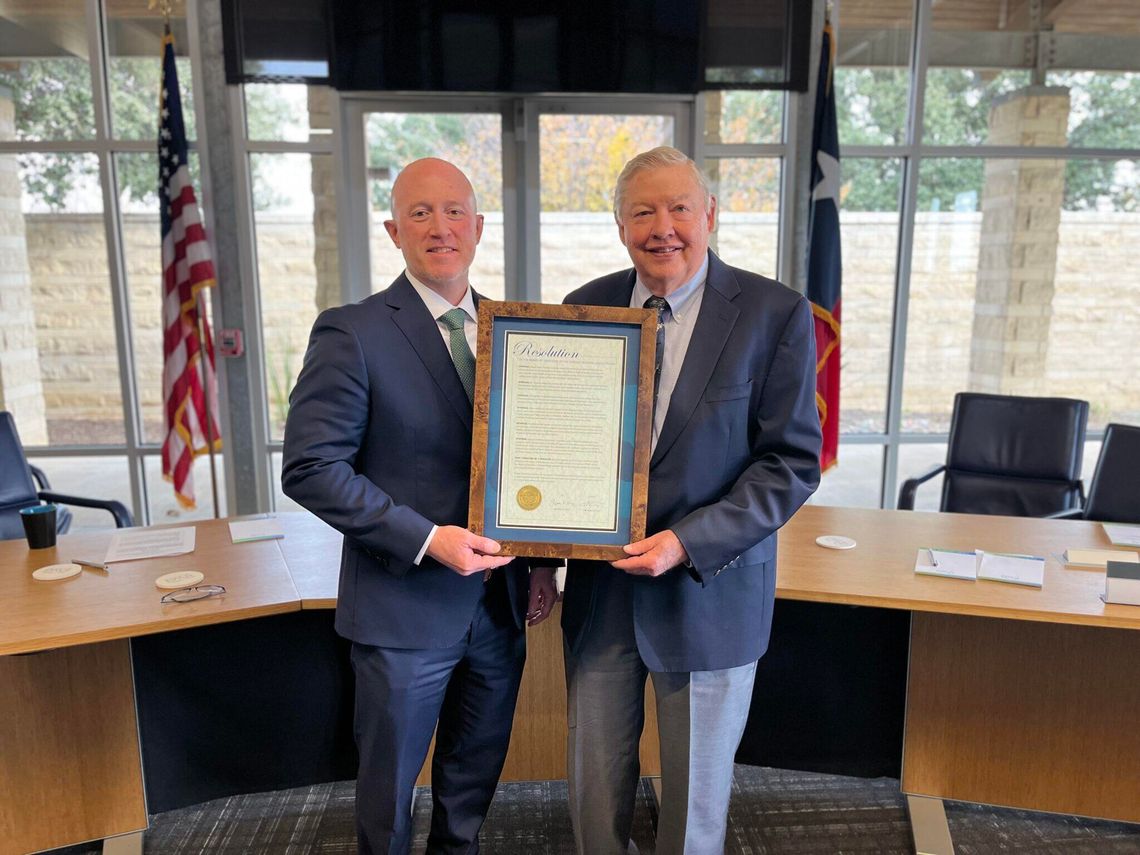
Robert “Alan” Thomas may have been “making waves” at Tarrant Regional Water District since he was 17 years old, but now, this deputy general manager is ready to “tap” out from his 52-year career.
Thomas first got his feet wet at TRWD in 1968 when the district decided to hire several school-aged boys to work at the Eagle Mountain, Bridgeport and Fort Worth offices. As a general maintenance worker, Thomas spent his time learning how to weld, operate trucks and tractors, assist with floodway issues and support the district’s Eagle Mountain operations.
After high school, Thomas worked part-time in the Fort Worth office in field operations before transitioning into the operations administration side. While he was earning his accounting degree, Thomas was invited to work part-time as an accountant, became a full-time employee in 1974, and it wasn’t long before he landed the position of manager of finance and administration.
Throughout the rest of his distinguished tenure, Thomas continued to hold several key leadership roles, including manager of operations and administration, assistant general manager and finally, deputy general manager.
While Thomas said there’s not a “nickel’s worth of difference” between the positions of assistant general manager and deputy general manager, he said he always strived to handle any obstacles that came his way —everything from the water supply and flood control aspect of the district to the recreation side.
“There’s new challenges coming up right now,” Thomas said. “The city and most municipalities have a five to 10-year plan on the horizon; we have a 50-year plan. Everybody’s looking right now at, ‘What is the next source of water that’s going to take us through the next 50 years?’”
GUIDING THE CURRENT
Although Thomas admitted he did have a desire to start looking for another job after working at TRWD for four years — mainly due to the routine nature of being an accountant prior to technology — he said that all started to change once his team started working on the Richland-Chambers water supply project.
“I got to be involved in planning for the next 50 years,” he said. “I got to work on the contract with Fort Worth, Arlington and Mansfield, and then we started building the Richland-Chambers Project. Once you start building a project like that, you’re not going to leave.”
Plans were made to construct the Richland-Chambers Reservoir and inundate Lake Corsicana after a drought took place in the 1950s. However, no action was taken until 1979, when the water district issued $342.75 million in revenue bonds for construction. Dam construction began in October of 1982, and the reservoir was completed in November of 1987. The Richland-Chambers Reservoir started to transport water to Lake Benbrook for water supply to the Tarrant County area in 1988.
Since then, Thomas has played a pivotal role in shaping some of the region’s most impactful water supply projects, including Benbrook Pipeline, Eagle Mountain Connection Pipeline and the Integrated Pipeline Project in partnership with the city of Dallas.
The Benbrook Pipeline Project allowed TRWD to take water from East Texas and pump it into Lake Benbrook during the winter months, when utility rates are typically low. Thomas explained that TRWD usually holds the water in Lake Benbrook until the peak summertime demands, when the water is pumped into other areas like Arlington, Fort Worth or Mansfield.
After TRWD successfully completed the Benbrook Pipeline Project, the team began to work on the Eagle Mountain Connection Pipeline which has improved the reliability of Eagle Mountain and Bridgeport Lakes.
“We take water all the way from East Texas, and we bring it all the way around to Eagle Mountain,” Thomas explained. “We’ve probably got 85% of our water supply in East Texas and probably 90% of the demand is in Tarrant County, so we move it around to Eagle Mountain because Eagle Mountain feeds both Fort Worth and Azle, so we put it there to try to slow the drop in the lake levels in Eagle Mountain and Bridgeport.”
The latest project, the Integrated Pipeline Project, was created as a third pipeline to allow Tarrant County to have access to more water through Lake Palestine to help offset the increasing demand due to population growth. According to the TRWD website, this project gave both TRWD and Dallas water utilities the ability to bring an additional 350 million gallons of water per day into the metroplex.
“The reason it’s called Integrated Pipeline is because we integrated our system with the city of Dallas to basically build on and operate that pipeline system,” Thomas said. “We’re still in the process. We’re just about to let the final two contracts on the Dallas section, and then our system and Dallas’ system will both be integrated so that we can use both if something unforeseen happens.”
Thomas said that “without a doubt” the Eagle Mountain Connection was the most rewarding project to be a part of due to the positive impact it has had — both on the community and the lake levels.
“Right now, the lake is a little over two feet down,” he said. “In my career, the most it’s been down has been about 13 feet, but Bridgeport has been down 30 feet. Mother Nature could still deal you another blow on drought, but this project has really had a positive impact. Without the Eagle Mountain Connection, both Eagle Mountain and Bridgeport Lakes would have been about eight feet lower than they actually were, so that’s why I’m saying it’s had a positive impact.”
UPSTREAM AHEAD
While Thomas stayed busy throughout his 52 years, he explained it’s nothing new in the world of water supply. In fact, he said it can take decades for TRWD to build a new reservoir.
“If we were going to build a new reservoir right now, it would take 25 to 30 years,” he said. “By the time you get all the permitting done, all the land required, all the infrastructure built, it would take 30 years before you’d be able to deliver a drop of water.”
With several projects already completed, the work does not stop flowing for TRWD — literally.
“Right now, we’re looking at, ‘What is the next source of water supply?’” Thomas said. “The demands are starting to dictate now that we need to build another pump station and another pipeline at Richland that intersects the existing integrated pipeline. Richland is our largest source, so we’ll be able to bring more water from Richland into Fort Worth.”
Since Thomas has spent the better part of five decades at one of the state’s largest raw water providers, he said his most difficult project yet won’t be planning a new reservoir — it’ll be retirement.
“It’s really hard to retire because it’s still fun,” he said. “The hardest part to leave is not being a part of the planning that you know is going to happen for the next 50 years. But I mean, it’s been fun. I couldn’t have asked for a better job.”
While Thomas has immense pride in the many contributions he’s been a part of at TRWD, he said that’s not the only thing that has kept him coming back year after year; it was the team effort from staff that has spanned multiple generations and decades.
“The people at the water district, they’re probably the most dedicated, loyal and competent people that you could ever work with,” he said. “The thing that has kept me coming back is the people … We’ve had some really talented people, and we have some really talented people right now. Everything we’ve done has been a team effort.”
SMOOTH SAILING
While Thomas said it will be hard to walk away from TRWD — one of the biggest constants in his adult life — he said he knows the district has another visionary in place in Dan Buhman to lead the district into the future.
“When we changed general managers in 2021 the new general manager and I started evaluating staff, and we looked at who we had,” Thomas said. “In 2021, I was 71 years old, and I was already thinking about retirement, so we identified, in a nutshell, the next generation of people. The reason that I think now is the time is because we have an incredibly talented leadership at the district at this level, and we've got an incredibly talented staff at the next level.”
From 1974 to 2026, TRWD has grown from a staff of about 100 to a hardworking team of about 400. With this year’s team of dedicated and talented staff, Thomas said he ultimately had no problem retiring, knowing that TRWD will be in excellent hands.
“Knowing the people that are involved and knowing what they have to accomplish, I have zero doubt that they’ll be successful,” he said. “They knew so much more than I did coming in the door and that’s why they’ll be much more successful.”
As Thomas prepares to spend more time with his three great-grandchildren playing sports and “sharpening up on his Barbie skills,” he hopes to continue watching TRWD’s success from the sidelines — though he admitted it will be hard to step away completely.
“I’d like for TRWD to get a little more movement out of the federal funding, so that they can complete the Trinity River Project; that’s a biggie,” he said. “Since I’ve been mostly involved in the Integrated Pipeline, my involvement in the Trinity River Project has been secondary, but they’ve got some really good people working on that, too … If we can get that going and get that finished, it’ll change flood protection in basically most of Fort Worth.”
On Thomas’ last day at work — Jan. 9 — he officially left TRWD knowing his dedication never ran dry and that it’s up to the next generation to keep the district running without a leak.
“If knowledge is power to you and if you try to keep everything to you, you’re failing as a manager. You have to make sure that the next people, that if something happens to you, they won’t even know you’re gone — and that’s where we are right now,” Thomas added. “We’ve got it. We’ve got a great staff — and they won’t miss me for a second.”