 ASHLEY TERRY

Boaters and water crafters who frequent Eagle Mountain Lake will have to pay a bit more attention to how close they get to the shoreline, docks and other boats this summer.
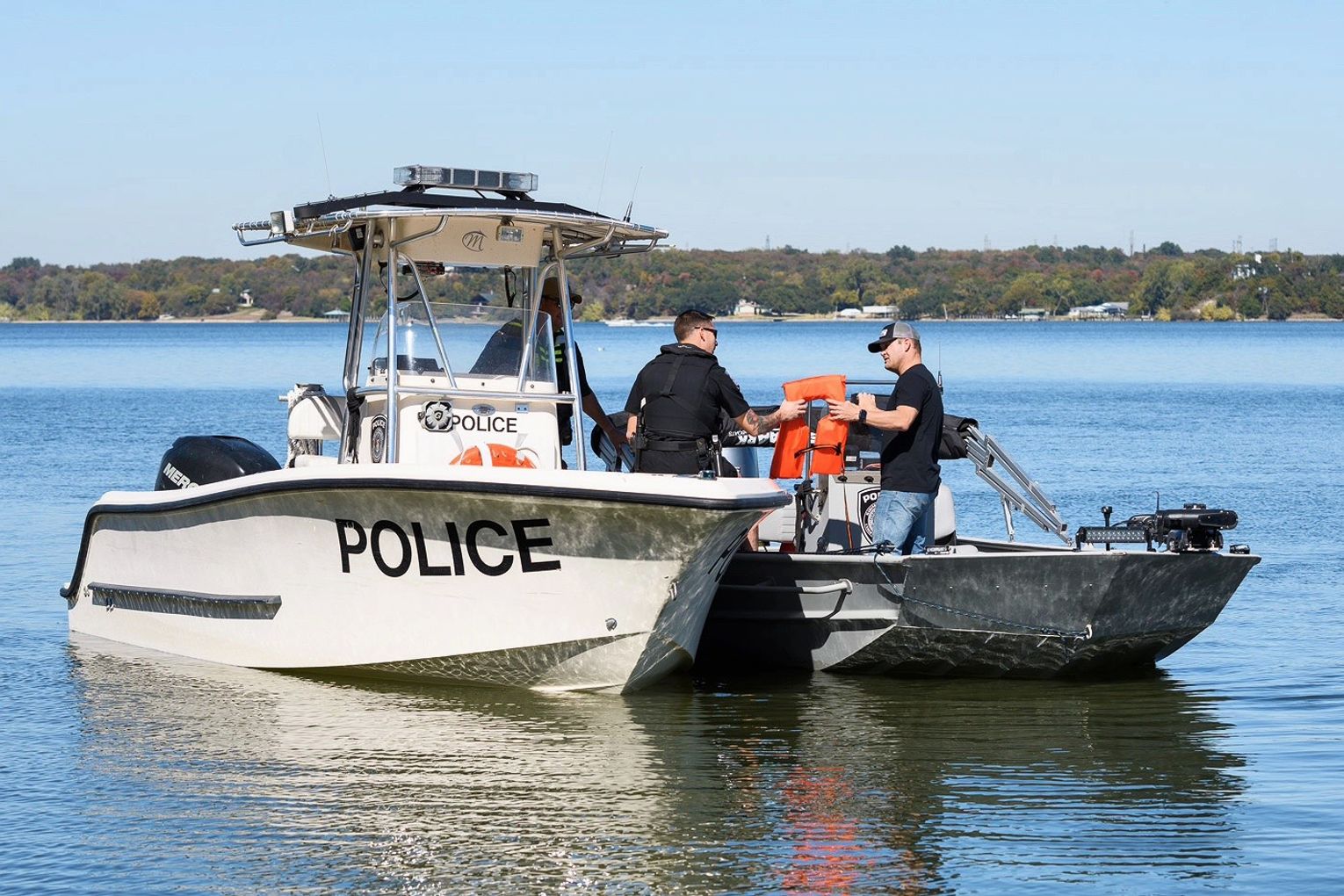
Lt. Chris Akers and Sgt. Rick Odom of Tarrant Regional Water District’s Law Enforcement Division recently sat down with The Azle News and Springtown Epigraph to discuss the various updates to the district’s general ordinance — along with the biggest change that will affect every lakegoer.
“In state law, watercraft cannot come within 50 feet at headway speed (the slowest speed at which a vessel can maintain steering) to another watercraft, shore or boat house,” Akers said. “However, the water district, years ago, had adopted its ordinance to be 100 feet — but this new ordinance change pushes it to 200 feet.”
According to Akers, TRWD’s ordinance is stricter than state law, which means it supersedes the 50-foot Texas law on district-controlled waters.
“Kind of like cities, this gives us the ability to control at a local level what we need, so it just makes it safer,” Akers said. “We have community buy-in, and that’s kind of how we went with this process. Staff just needed an update because the ordinance hadn’t been updated in quite a few years, since probably the early 2000s, so just over time, it needed to be changed.”
Akers said the main reason for the stricter update is due to Eagle Mountain Lake’s ever-growing population, which has already led to a few accidents.
“Even last year, we had a watercraft strike a dock, and they violated the 100-foot ordinance,” Akers said. “I mean, there’s no way you’re going to hit the dock (with this ordinance). There are no docks that are more than 100 feet away from the land. Boats don’t have brakes, so this just increases that distance from each other to prevent any boat from striking a dock or another boat.”
Akers said Eagle Mountain Lake started to see a rise in population during the COVID pandemic in 2020, as more residents were out buying boats to combat social distancing — and the growth has not stopped since. Even today, EML’s population on a typical Saturday is measured by volume since its overall size and shoreline length are smaller than Lewisville Lake, but it still often holds more boats per square mile.
“If you took Lewisville and shrunk it down to our lake, we would have more boats in it than Lewisville, so we’re steadily increasing,” Akers said. “I’ve been with TRWD’s Law Enforcement Division since 2005 and every year, it’s more boats and more boats.”
Odom said the continuous construction of new homes along Eagle Mountain Lake — and the fact that each home also comes with a dock on the property — is another major factor that contributes to the lake’s population.
“We have several subdivisions around the lake that are new and upcoming and they’re building houses and everybody’s getting their own dock, so they’re going to be keeping boats up there; it’s just continually growing,” Odom said.
Although TRWD’s main mission is to promote safe recreational activities, Akers said the push for an updated ordinance was a team effort and involved collaboration from not only TRWD’s board of directors but also input from community stakeholders like Save Eagle Mountain Lake, a nonprofit organization dedicated to preserving the lake.
“This ordinance extends more than just Eagle Mountain; it extends to all our reservoirs and all our properties — Bridgeport, Richland-Chambers, Cedar Creek and Eagle Mountain,” Akers said.
While the new changes and updates to TRWD’s ordinance were officially adopted by the board of directors in December 2025, Akers said there will be a “grace period” for boaters to adjust to the 200-foot rule. Signs are also expected to be posted on all boat ramps by Memorial Day.
“I think for the 200-foot rule, the grace period is probably going to last through the year, but I mean, it’s going to be case-by-case. It’s up to discretion, but it also depends on the severity of the case,” Akers said. “The 200-foot rule is going to be a big change, especially for some of the wake surfers that like to get close to the shoreline to get a better wave — that’s going to affect them some.”
Odom explained that the members of TRWD’s Law Enforcement Division are hoping to see voluntary compliance from every single individual on the lake this summer — even if it takes several months to spread the word.
“A lot of what we do on the water is emergency response, but it’s also public education,” Odom said. “A lot of the boaters that we come in contact with who are violating even the 100-foot rule, they’re still responsible for their wake. If they’re creating these three- or five-foot wakes doing wake surfing, those wakes are damaging boat docks, boat houses — everything. But a lot of them don’t realize until we stop and converse with them for a little bit … so we’re glad to be able to push this out to the public because it is a big change.”
Akers said he wants to encourage every frequent visitor to EML to visit TRWD’s website and take a look at the ordinance changes by clicking the “Who We Are” tab and scrolling down to the “Board of Directors” link.
“They need to understand — you have to follow Texas Parks and Wildlife rules and the water safety code, but you also have to follow the stricter guidelines that we have,” he said. “It’s all about safety — and that’s why we increased the (minimum approach distance) to 200 feet. It isn’t like we’re going to write a bunch of tickets, but we are going to try to get some really good educational information out there.”
To read the entire ordinance — or to just read a summary of the key updates and modifications to the 2025 proposal — visit trwd.com. Individuals who have questions are welcome to reach out to the TRWD dispatch center at 817-720-4584.