 ASHLEY TERRY
Every school district has an area of weakness — and for Azle Independent School District, that area is math.
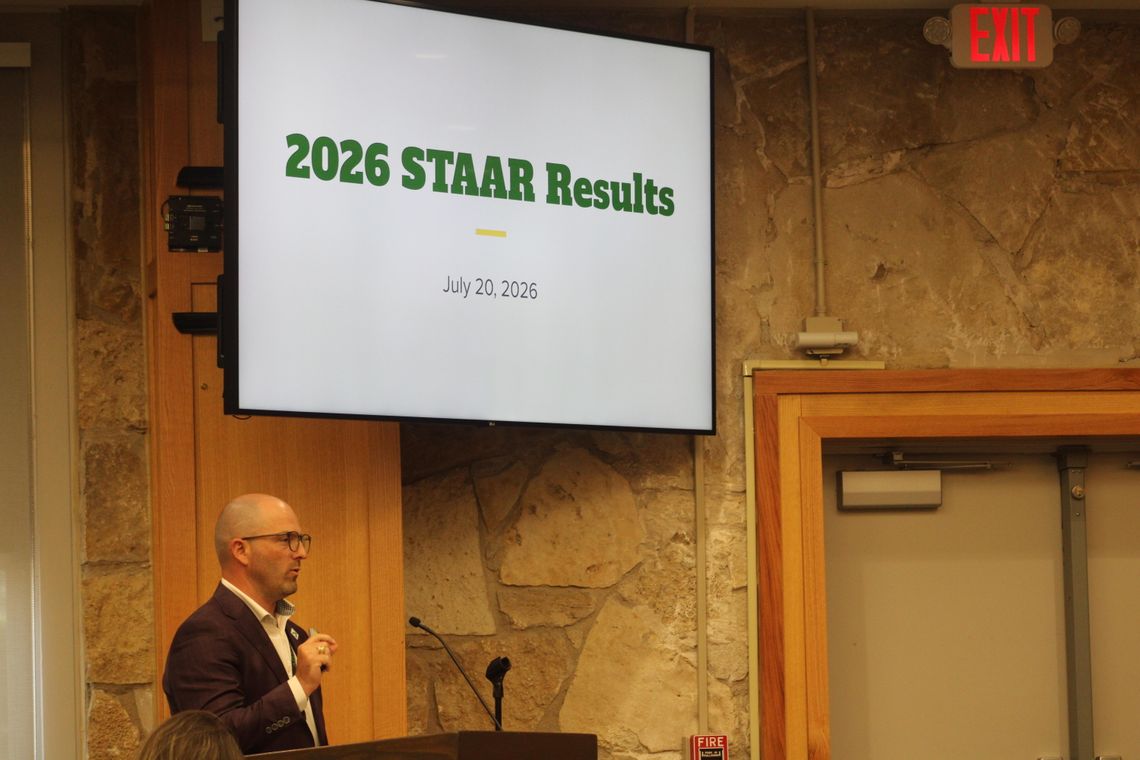
Jordan Thiem, AISD’s director of secondary curriculum, presented the board of trustees with the results of the 2026 State of Texas Assessments of Academic Readiness, commonly known as STAAR, July 20. While the district had many areas of success, he explained that math continues to be a challenge, particularly in the third through eighth grades.
“Math, for the most part, is really our Achilles’ heel,” Thiem said, “but it’s something we’ll continue to work on.”
According to the STAAR results, AISD ranked below the region and state in the “approaches grade level,” “meets grade level” and “masters grade level” performance criteria in math.
However, Thiem reminded trustees that AISD implemented a new math curriculum just last year, which could have played a role in the lower STAAR results during the transition.
“It’s pretty different than what we’ve had in the past and it did take some time to learn,” Thiem said. “We’re hoping we can hit the ground running this year with that.”
Despite ranking lower in the “meets” category for English language arts, AISD’s results were stronger than those in math, with the district surpassing both the state and region in the “approaches” category.
“The systematic approach that we’ve taken for English over the last couple of years is starting to take a foothold where it’s actually building on itself,” he said, crediting that achievement to district humanities coordinator Julie Hall.
The same can be said for science, with more students “approaching” and “meeting” their current grade levels compared to the state and region.
“This is something we’ve really been building on because we’ve had a new curriculum inside of the science for a little while,” Thiem explained. “The fact that we have a larger amount of students there (in the ‘meets’ category) is a big deal for us.”
Although 26% of students in eighth grade and U.S. history did not meet their grade levels on the STAAR test, Thiem pointed out that 74% did — and a higher percentage scored in the “meets” category compared to the state and region.
After going over the results, Thiem explained that the district has a few areas that need to be addressed, with the biggest problem area being math in grades 3 through 8, followed by eighth-grade social studies and third-and eighth-grade English language arts.
Even so, Thiem pointed out the district does have some “bright spots” that need to be celebrated — plus many more areas that are improving every day.
“We are above the state and the region in ‘approaches’ and ‘meets’ categories in English I and II, and we have even larger gains inside the ‘masters’ category at the high school level,” he said. “We are above the state and region in ‘approaches’ in language arts for fourth, fifth, sixth and seventh in English I and II … and above the state and region in ‘approaches’ and ‘meets’ in U.S. history with gains in masters.”
One of those bright spots, Thiem said, has been an improvement in the extended constructed responses at Azle High School, which can be attributed to the “Ban the Blank” initiative.
“A lot of this just has to do with getting kids to write in a response,” Thiem said. “We’ve actually had a large amount of students who just leave it (a writing prompt) blank, so there was a big initiative at the high school for ‘Ban the Blank,’ and that has made a really large change … We’ll start having that same initiative data for junior highs all the way through sixth grade.”
Thiem explained that many times, students have a hard time showing initiative in writing and said the district’s solution is to ask students if they could just rewrite the prompt, as two points is a “heck of a lot better” than zero.
“(We asked), ‘Can we just start somewhere and write something down?’ and we saw the gains for it,” he said. “Not to say that we outpaced the data, but our average changed just because we have less zeros than we had in the past.”
With third grade specifically struggling the most in the district, Thiem said AISD has started facilitating additional small-group conversations and implementing more tactile, hands-on learning instead of relying as heavily on iPads and other forms of technology.
“The younger kids, they’ve been exposed to more technology than the older kids, and it's something that we are slowly trying to pull away from, and it's something that's already being addressed by the tech department,” Thiem said. “It’s more of a whole district initiative; not just a curriculum initiative — more pencil and paper, more writing, more talking to the person next to you and less YouTube videos.”
While Thiem said these STAAR test results aren’t exactly what the district wanted to see, they have been helpful in determining which campuses need the most support.
“There are definitely some things that need to be addressed,” he said. “I’m glad that we already started last year with having a new math curriculum already adopted because I'd hate to see what would happen if we had to start that this year with reconfiguration and not addressing that soon enough. Right now, we're just waiting to see the fruits of our labor because sometimes you have to see (something take a) hit before you see it rise back up.”