 ASHLEY TERRY
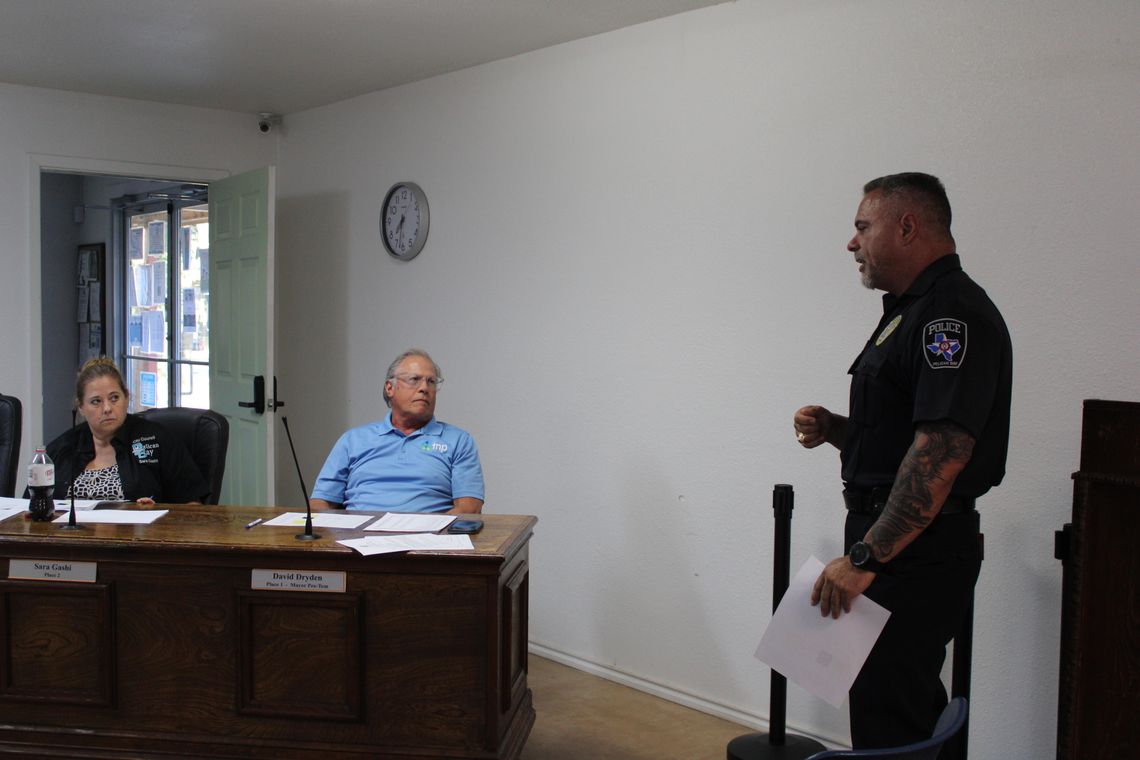
As Pelican Bay city officials continue working toward a balanced budget, Police Chief Brad Anderson helped fill in some of the blanks surrounding his department’s staffing and operations during a budget workshop July 28.
Council members were left with several questions during a previous budget workshop July 14, after learning the police department had exceeded its fiscal year 2026-27 payroll budget by approximately $200,000.
While last year’s payroll budget was $385,000, Mayor Tamra Olague previously explained that this year’s proposed $587,000 budget includes the loss of a grant for one officer position and the department’s transition to full-time staff.
Although rumors have circulated that part of the payroll increase is because of several new officers on staff, Anderson said the city only has five full-time officers.
“I’ve been hearing a lot that we have 13 paid officers; we don’t,” Anderson explained. “We have 13 people who are carrying commissions. It’s a completely different thing.”
Along with the department’s five paid officers, Anderson explained that several reserve officers are either nonpaid employees or currently in the hiring process. He added that he hopes to hire a sixth officer soon on a 32-hour schedule, which will help with overnight coverage and require less reliance on the Tarrant County Sheriff’s Office to fill in the gaps.
“Tarrant County does come out and patrol,” he said. “We do have an agreement with them right now to where they handle all our crime scenes, major accident investigations, sex offender registrations … They come out and back our guys up, so we have all those resources that we do pull from a lot … but we’re getting to where we have way more coverage than we used to.”
Anderson explained that the department currently operates on four 10-hour shifts — leaving about four hours each day without any patrol coverage — but he added that many of his staff also assist in other areas, like code enforcement and animal control.
“We’re doing as much as we possibly can with what we have. We know there’s always more to do, and we’ll do everything we can moving forward,” he said.
Place 5 Alderman Kathy Bender explained that the quality of the police department isn’t an issue; it’s the coverage, and Olague agreed.
“I know we have quality officers, and Chief and I had discussed that,” Olague said. “In the beginning, we didn’t want to hire a bunch of young, gunning ‘make a name for yourself’ officers — but if you compare us with other cities, we’re the 13th lowest-paying city in the Dallas-Fort Worth metroplex.”
Anderson said the department also prides itself on only hiring recommended officers instead of “blindly hiring” just anyone who applies.
“It's been a slow process — a tedious process — but we're getting some extremely high-quality guys,” he said. “Any other people who work in that network can step in and do my job any day of the week — that's the level of people we have.”
While council members praised the quality of the police department, one question still remained: how will the city cover the proposed $200,000 increase in payroll?
Even though the council could decide for itself where to cut from the police department’s budget, Bender asked Anderson if he had any ideas, adding that they need his input and expertise before making any decisions.
Anderson told council they could cut, “wherever they’d like,” whether that means a hiring freeze, reducing the number of part-time positions or converting some full-time positions to part time.
“I only spend what y’all give me. If y’all give me all the money in the world, I’m going to spend it,” he said, chuckling. “But if you got to cut back, you got to cut back — and I’ll make that work as well … We’ll do what we have to do to make the budget work and get y’all the best service we possibly can.”
FUNDING THE FUTURE
Beyond police staffing, council also reviewed employee benefits, infrastructure needs and the city's overall financial outlook.
While many of the city’s expenses — including health insurance, liability coverage and electricity — increased this year, Olague said the city is expected to generate enough revenue to offset those costs.
“I’m projecting that the revenue for the year will be $1,655,117,” she said. “Now, that number is going to change once I get our tax rate in — because I’m really just guessing on what the no-new-revenue rate is going to be — but my expenses are exactly the same, so I’ve got it at zero.”
One proposed cost-saving measure, Olague said, includes opting out of Social Security for city employees and instead, increasing the city’s investment in the Texas Municipal Retirement System.
“We’ve been talking about ways to be able to save the city money, and one of the things that we discovered is that if we have our own retirement plan that is within what the government requires us to have, we do not have to pay Social Security,” Olague explained.
According to Olague, the city currently withholds 6.2% from employees’ paychecks for Social Security and then matches those deductions at 100%. Since the city spends anywhere between $54,000 and $70,000 a year in Social Security, Olague proposed discontinuing its participation and increasing employee TMRS contributions from 6% to 7% — a move she said could save the city as much as $30,000 a year.
“It is a good way for us to save money,” she said. “It's a good way for us to invest in our staff by giving them that 6% back and letting them put that into their retirement benefit by allowing them to put more in and for us to match it at a higher rate.”
With these changes, Olague said the city would save around $15,000 in the general fund, nearly $12,000 in the utility fund and a “lot of savings” in the police department budget.
“Overall, they (city employees) are getting more benefits in their retirement fund, (because) they’re getting more money on their paycheck,” she said. “They can do what they want to do with that money — they can invest it or put it in their pocket and spend it.”
Olague said the city also anticipates an additional $90,000 in revenue from the sale of a property at 1333 White Sands Drive, which is expected to go before council Aug. 11. If the sale is approved by council, Olague said she hopes to spend these funds on park improvements and street repairs, particularly Sherry Lane and Long Avenue.
Pelican Bay City Council is expected to consider the proposed budget and no-new-revenue tax rate Aug. 25.