 ASHLEY TERRY
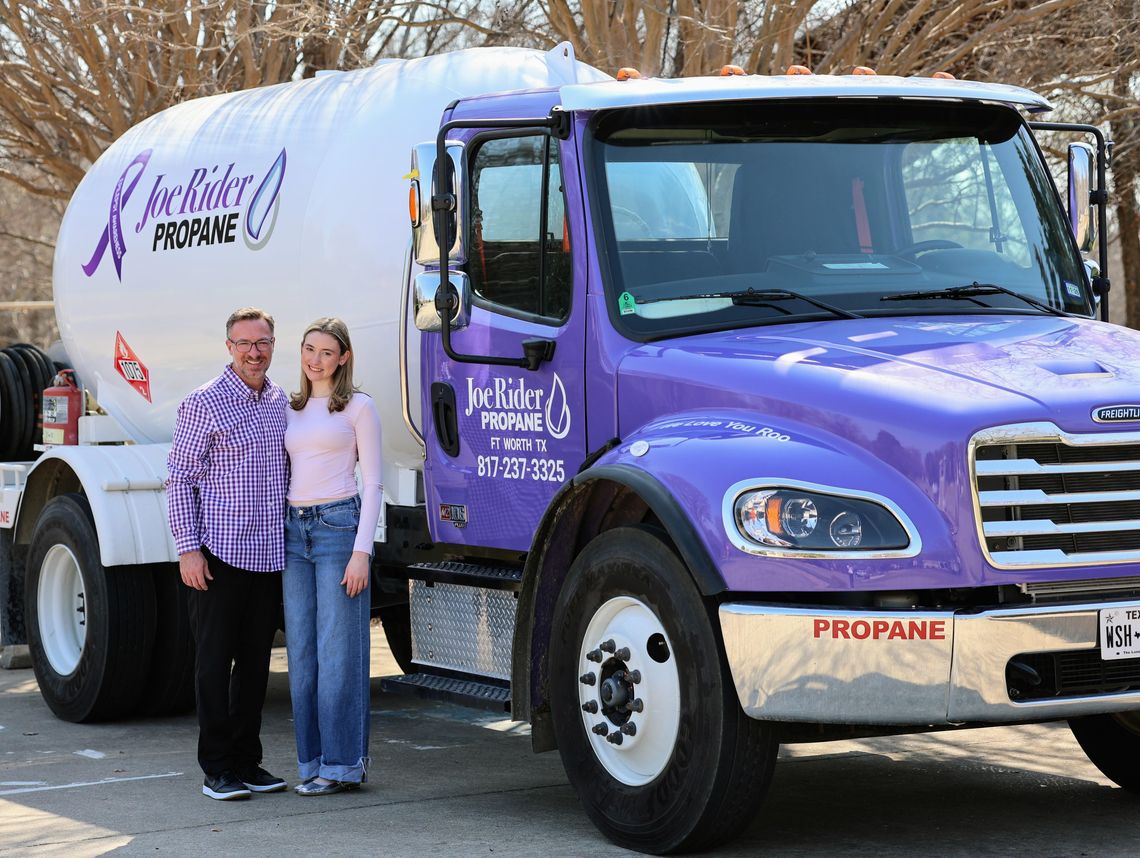
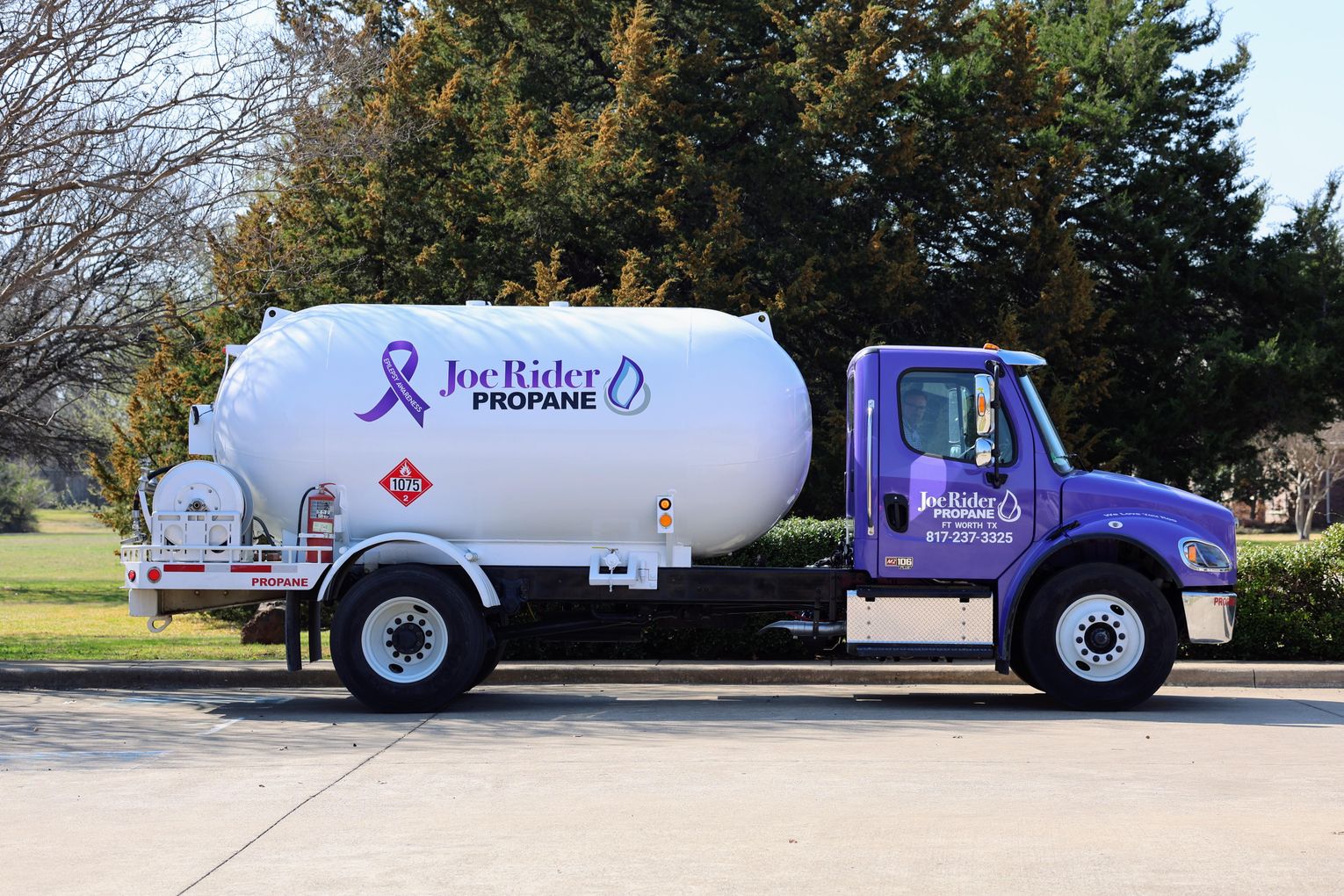
A bright purple propane truck will make the rounds across four counties this winter — delivering not just propane but a reminder of how far fathers will go to support their daughters.
Cody Savage — owner of Joe Rider Propane on Jacksboro Highway — recently transformed one of his propane delivery trucks in honor of his 17-year-old daughter, Ryleigh, and her 10-year journey with epilepsy.
“In the propane industry, there’s lots of breast cancer awareness,” Savage told The Azle News. “One day, I was reading a trade magazine and saw a breast cancer awareness truck and got the idea. I was like, ‘You know what? I’m going to do an epilepsy awareness truck in honor of Ryleigh, and it’ll make her feel special.’”
Unbeknownst to both Ryleigh and his employees, Savage went to a dealership and shared his vision for a custom company truck — complete with a vivid purple cab, an epilepsy awareness ribbon and matching purple accents.
“The drivers have been really excited about it,” Savage said. “I drove it home one day and showed it to my family and they loved it. When Ryleigh first saw it, she just walked over and she’s like, ‘Daddy, I love it.’ It was the moment I was wanting. She was so proud.”
Because winter is normally the company’s busiest season, Savage said the plan is to have his employees rotate the truck on a set schedule to help spread awareness about epilepsy during their delivery routes, which range from south of Granbury to Justin.
“(We deliver to) four counties,” Savage said. “We go until maybe 10 miles west of Springtown and as far east as Keller, all the way up to Argyle, so it’s a big area that it will get seen.”
HIDDEN IN PLAIN SIGHT
Savage said Ryleigh was first diagnosed with generalized idiopathic epilepsy with absence seizures — characterized by sudden, brief blank stares — when she was in first grade. He explained her condition was initially misdiagnosed as attention deficit disorder and later thought to be night terrors because her seizures were so short they often went unnoticed.
“Most of the time when you think about an epileptic, you think about somebody laying on the ground (convulsing) and those are called grand mal seizures,” Savage explained. “But Ryleigh’s seizures were bursts that were one to three seconds long and she may have 60 of them in an hour.”
Because Ryleigh’s seizures only lasted a few seconds at a time, Savage said it was easy for her to miss key instructions at school or not notice when someone was calling her name.
“She would just kind of not pay attention … and we just thought she was being disobedient,” he said. “We would keep calling her name and then she's finally like, ‘What? Why are you screaming at me?’ But we were able to get her to Cook (Children’s Medical Center) in Fort Worth and get her on medicine that worked.”
NEVER DEFINED
While the diagnosis was a shock to the whole family, the hope that Ryleigh may someday grow out of it helped her maintain a positive attitude and an upbeat outlook on life.
“She was really up-spirited and was always like, ‘God gave me this for a reason, and I'm going to use it,’ and she was always really trying to help other kids that might have epilepsy,” Savage said. “She's really had a heart for that kind of stuff, like she would have her birthday parties, and she would have all the kids bring gifts that she could then take to Cook Children’s and donate to other kids with epilepsy who had it worse than she did.”
Savage said the seriousness of her condition didn’t set in for Ryleigh until her seventh-grade year, when she experienced her first grand mal seizure in the back of the car on the way to school.
“It was a traumatic event,” Savage said. “We were at a stop sign, and I was going to turn left, so I just happened to turn to make sure there was no traffic coming, and I caught her out of the corner of my eye … As most teenagers, she just wanted to dismiss it. In her mind, it was like, ‘Well, I don't want this anymore, so I'm just not going to have it.’”
Despite her diagnosis, Savage said Ryleigh went on to become an “incredible athlete,” and played on both the varsity soccer team and basketball team at her school, Grapevine Faith.
“She has this attitude of, ‘This is not defining me. Don't treat me different. I don't want teachers treating me different,’” Savage explained.
THE TURNING POINT
Ryleigh’s stubbornness with her epilepsy, Savage said, continued until her junior year of high school, when she missed two doses of her medication and suffered a six-minute grand mal seizure during the first basketball game of the season.
“She has to take her medicine every 12 hours, so every morning, every evening … but it was a battle to get her to take her medicine. It was still just like, ‘I don’t want to deal with it,’” he explained. “She didn't take her medicine Friday night, Saturday morning … She got up Saturday morning, went to her game … She’s standing next to her coach, and the coach is kind of talking to her about the play coming, and she literally goes into a grand mal seizure, and he just catches her, takes her to the ground and holds her.”
While it was an embarrassing moment for Ryleigh, Savage said it was the perfect wake-up call she needed to start taking her medication — and epilepsy — seriously.
“It’s like she had to have that moment that was in front of all of her friends for it to really click like, ‘OK, I need to take care of myself,’” Savage said.
Today, Savage said Ryleigh is staying on top of her medication and recently spent two and a half weeks in Europe.
“She’s thriving, like she’s really trying,” he said. “She hopes to go to the University of Oklahoma where her sister is.”
BEYOND THE DIAGNOSIS
While Savage’s truck was inspired by his daughter’s journey, he said he hopes it will spark more conversations about epilepsy and help educate others about a condition that is often misunderstood.
“Epilepsy, it's a really rare thing, and because it's rare, I don't think it gets a lot of education or knowledge,” he said.
Savage’s wife, Mandy, said knowing what to do when someone is having a seizure can be just as important as recognizing one. She explained taking simple measures such as comforting the person and ensuring they’re in a safe place can go a long way toward helping someone during a seizure.
“A lot of times, people are disoriented,” Mandy Savage said. “Don’t try to hold their tongue, don't try to hold their head and don’t try to restrict them because if it is a grand mal, a lot of times that comes with jerking and that can be more dangerous.”
She said overall, she wants the public to know that there’s different types of epilepsy and it’s more common than people think.
“It affects one in 26 people — that’s an elementary classroom,” she said. “When people first get that diagnosis or they hear of epilepsy, they think life as you know it is over … That is definitely something a lot of people think — that they can't drive, that they can't live life — but they just have to adjust their expectations and be extra cautious.”
As residents start seeing the epilepsy truck this winter, Cody Savage said he hopes they begin seeing epilepsy differently — and not just as someone’s diagnosis.
“Ryleigh is proof you can do anything any other kid can do,” he said.