 ASHLEY TERRY
Weeks after announcing a potential budget deficit — and asking city department heads to propose 20% budget cuts across the board — Azle officials are now proposing a property tax increase to help balance next year's budget.
During the Aug. 3 Azle City Council meeting, members voted unanimously to propose a de minimis property tax rate of $0.6756 per $100 of taxable value — around an 8% increase compared to the current rate of $0.6246. Since this is a proposed tax rate, council members will hold a public hearing on the rate Monday, Aug. 17, with adoption scheduled for Monday, Aug. 24.
According to finance director Angelia Garrett, the city’s certified taxable property value only increased 1.16% this year, which city officials say is not enough to sustain Azle’s current operations without raising the tax rate.
“Certified values are established annually by Tarrant and Parker County Appraisal District and not the city. These values are the basis of our calculation that we use for property tax revenue, and as the tax bases change, it affects the amount of revenue that we can generate to provide essential city services,” Garrett explained. “As the total taxable value increases, each penny of the tax rate generates more revenue.”
Garrett explained that the city’s maintenance and operations tax rate — which is used to fund day-to-day operations such as police, fire, parks and library services — is increasing, while the interest and sinking portion, which pays debt on capital projects, is slightly decreasing.
Despite the decrease in the I&S rate, Garrett said the increase in the M&O rate more than offsets it, resulting in a net increase of about $0.051 per $100 of taxable value.
Garrett said if approved, the de minimis rate would be applied to the current year’s certified taxable property value to levy approximately $13 million for maintenance and operations, debt service and tax increment reinvestment zones.
The proposed de minimis rate exceeds the no-new-revenue rate, meaning it would generate additional property tax revenue beyond what the city would collect from existing properties under the no-new-revenue calculation.
RESIDENTS PUSH BACK
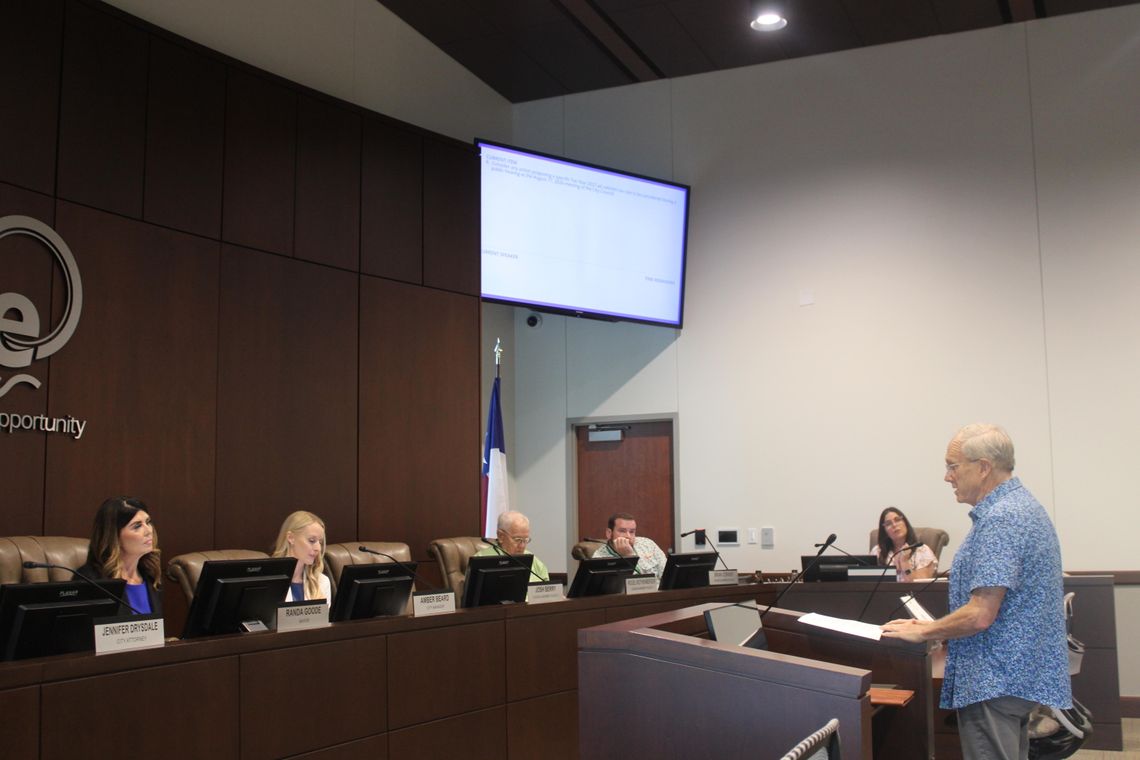
During public comments, Azle resident John Fowler expressed concern about how much the proposed tax rate will affect Azle’s “low-income homeowners.”
“The median income in Azle is $68,000 per year, and one-third of the Azle homeowners are on a fixed income,” Fowler said. “Apparently, the Azle mayor and city council will approve any tax increase proposed by the city manager, regardless of its impact on low-income homeowners.”
Because he said so many residents are on a fixed income, Fowler asked council to consider approving the no-new-revenue rate, which would allow the city to collect about the same amount of property tax revenue as last year.
“In the workshops in the past, I saw a lot of discussions about balanced budget, but if balanced budget means balanced on the back of an 8% property tax increase on citizens, then I guess they don't know what ‘balanced budget’ means,” Fowler said. “Property taxes doubling every seven years is unsustainable for many on a fixed income. Azle is not a wealthy town.”
Jerah Turner, who serves as Precinct 4340 chair for the Tarrant County Republican Party, explained that she wasn’t upset about the city needing more money due to rising costs — but she was irritated about how it was handled.
“When I left the meeting on July 21, I was assured that social media rumors of a nearly $3 million deficit were unfounded, and that the budget had been brought into balance through the appropriate cuts to the originally proposed figures,” Turner said. “That assurance has proven to be, I think, slightly incorrect.”
Turner said any claim about a budget being balanced should rest solely on the no-new-revenue rate and not on a tax increase that was introduced with “limited prior public scrutiny.”
She also argued council should scrutinize compensation and other expenses more closely before “shifting additional costs onto taxpayers in an already strained economy.”
“I did find some legitimate operational increases, but I think that this really needs to be looked after a little bit better,” Turner said. “That's the expectation from the residents.”
COUNCIL RESPONDS
Mayor Randa Goode explained that while the city’s initial proposed budget showed a $3.1 million gap, $1.75 million of that amount was a planned transfer from the general fund to the capital improvements fund for future projects. However, after determining it could not afford to set aside the $1.75 million this year, the city canceled the transfer, reducing the remaining budget gap to about $1.35 million.
From there, Goode said city staff was instructed to identify budget cuts of up to 20% — resulting in a hiring freeze, the elimination of cost-of-living adjustments, suspension of nonmandated training, staffing changes within the Azle Fire Department and reductions to the library budget.
Because of these changes, City Manager Amber Beard said the city was successfully able to reduce the budget by 8.7% from when it was initially proposed.
“We have worked very hard to get that (the budget) down, because if we didn’t, we were going to have to take funds out of our reserves,” Goode said. “If we continuously do that, at some point we’re not going to have those funds available and then we will be asked years later, ‘Why didn’t we plan for the future?’ This is us planning for the future.”
Goode explained that the proposed rate would increase the city tax bill on a median-valued home by an estimated $152 per year, which equates to $12 a month or 42 cents a day — and that’s only to maintain the same city services as today. She said the difference between the de minimis and no-new-revenue rate is only $80, but the additional funds will be enough to provide an “extra cushion” for contingencies and additional expenses such as rising health insurance premiums and electricity costs as well as wastewater plant chemicals and unfunded state mandates.
“All of us sitting up here, we are not immune to this decision. We have to pay taxes just like you do,” Goode said. “It’s a hard decision, but we've sat through the meetings, we've looked at the numbers and in order for us to prepare for the future and also maintain the services that we have, I feel like this is the best choice that we have at this time.”
Place 6 council member Brian Conner made a motion to propose a tax rate of $0.6756 per $100 of taxable value to be considered at the public hearing scheduled for Monday, Aug. 17. With a second from Place 5 council member Rouel Rothenberger, the motion passed unanimously.