 ASHLEY TERRY
The city of Azle is charting a course toward water and wastewater improvements that could shape its infrastructure for decades to come.
During the Azle City Council’s Oct. 20 meeting, members voted unanimously to adopt the city’s Water and Wastewater Master Plan, which will serve as a long-term planning tool to help the city identify necessary system improvements over the next 25 years. The plan was proposed and approved as part of the 2025-26 fiscal year budget in the amount of $55,000 and was updated by Jacob & Martin Engineering.
More than 25 years have passed since the city’s last comprehensive plan in 2000, and the new plan provides an updated assessment of the city’s existing water and wastewater infrastructure, system capacity, current and projected service demands and future infrastructure needs.
Following his previous presentation in September, Derek Turner, professional engineer with Jacob & Martin Engineering, returned to speak at the Azle City Council meeting to reiterate the recommended improvements.
Turner explained that the 2026 Water and Wastewater Master Plan covers both the city of Azle as well as its extraterritorial jurisdiction — the area outside the city limits — and evaluates population, land use, water supply, infrastructure, wastewater flows and financing.
“The plan substantially includes a lot of age-related upgrades to the water plan, the sewer plan and the system in general,” Turner said. “Those population projections resulted in a projected population in 2050 of 21,324, translating to just under 11,000 water connections and 11,500 or so sewer connections, with a sustained growth outlook over the next 25 to 30 years.”
WATER NEEDS
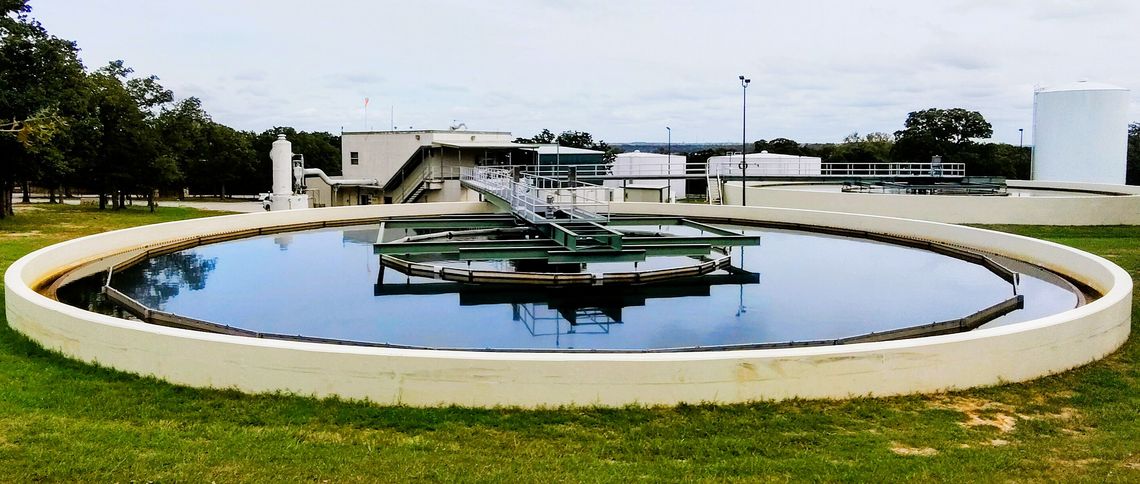
Turner said one of Azle’s biggest projected needs involves the water treatment plant, which has the most pressing time-sensitive capacity issue. With a current capacity of 6 million gallons per day, the master plan states that the plant is expected to reach capacity around 2039, which means a capacity upgrade planning process will need to start around 2027 or 2028 — when the plant is expected to reach 80% of its capacity.
Elevated storage is another area expected to become insufficient by 2029, which Turner said can be partly attributed to the age of the existing tank on Commerce Street. The tank holds 500,000 gallons, while the Castle Hills tank holds 1 million gallons. The plan recommends replacing the Commerce Street tank with another 1-million-gallon tank and adding additional elevated storage.
Other recommendations include adding a third clarifier and additional filter capacity, replacing 64,000 feet of 2-inch distribution line to improve pressure and fire protection and upgrading the high-service pumping capacity by 2045.
According to the plan, Azle’s water priorities over the next 10 years include replacing the 16-inch transmission line, replacing the Commerce Street tank, early filter and treatment work, and upgrades to the computerized systems, such as the Supervisory Control and Data Acquisition and programmable logic controllers.
WASTEWATER NEEDS
While Azle’s wastewater treatment plant may not face the same capacity concerns as its water treatment counterpart, Turner said many components are aging or undersized.
“The capacity was upgraded, I believe in 2010, and is projected to be sufficient through the planning period, so there's no capacity related upgrade recommended for the sewer treatment plant,” he told council. “However, the sewer plant is beginning to age … so the improvements to the wastewater side, again, really centered around age-related improvements.”
According to the plan, the wastewater treatment plant currently serves approximately 5,585 retail customers, plus 1,185 wholesale customers in the Pelican Bay area. With 88.2 miles of gravity mains, 13.7 miles of force mains and 23 sewer lift stations, the city’s wastewater system is projected to handle an average of approximately 2.21 million gallons of wastewater each day by the year 2050.
The plan recommends upgrades at the Charles Street, Liberty School Road and Broadway Road lift stations, plus major treatment-plant rehabilitation and control improvements.
“The 10-inch effluent line that takes effluent to the golf course was one of the major items we found that's in need of repair and upgrade, so one of the major items in the plan is to upgrade that line all the way to the golf course in the coming years,” Turner said.
According to Turner, the most immediate wastewater needs — identified for the first 10 years of the plan — include upgrades to both the Charles Street and Liberty School lift stations, an upgrade to the 10-inch effluent reuse line and upgrades to the wastewater treatment plant’s controls and equipment.
THE ROAD AHEAD
With $58.425 million in recommended water improvements and $31.826 million in recommended wastewater improvements, the combined cost of projects identified in the master plan totals approximately $90.25 million — but not all improvements need to be made right away, and taxpayers within the city limits won’t pay the entire bill.
The master plan separates near-term, midterm and long-term improvements, and the plan recommends matching project timing to system need, development and available funding.
For the first 10 years, the master plan recommends prioritizing improvements that address system reliability and immediate capacity needs. From years 10 to 15, the focus will shift to targeted distribution and treatment support, water pressure and fire-protection projects, and wastewater process and reuse improvements. During years 15 to 20, the focus will be on expanding water treatment and pumping capacity, improving wastewater operations and extending services to accommodate future growth.
Public Services Director Rick White clarified that the $90.25 million in water and wastewater improvements will not fall entirely on the backs of Azle taxpayers. In fact, he told the council, improvements associated with future development in Azle’s ETJ will instead be the responsibility of developers.
“We just don't want our public to see $90 million and think that burden falls to them, so we just want to clarify,” White said. “The plan is a plan. It’s a roadmap to get us to where we need to be. It doesn’t mean that’s the exact direction that we’re going to go. If a development comes in on the east side of town … then we’re going to work in that direction ... We may change our route, but this is the general direction that we need to go.”
According to White, some improvements are already in the pipeline, including the Charles Street lift station, which is expected to be upgraded in the next couple of years. For larger projects, such as the tank expansion or 16-inch transmission line replacement, White said the city has already put “some feelers” out regarding financial assistance and applied for a water grant earlier this year that could help pay for these projects.
“I wish I could see into the future and tell you what is going to happen,” White said, “but a lot of this stuff we’re going to be able to do in-house … We won’t know what we’re going to have to do as far as bonds go until we get to that point. We just need to know what direction we need to go.”
Funding sources identified in the report include impact fees, development contributions, annual budgeting, bond issues, special federal allocations and Texas Water Development Board financing.
The plan notes that water and sewer rates will likely need to increase regardless of the financing mix. The plan recommends the city use the project phasing and cost estimates as the basis for annual capital budgeting and then revisit the plan every five years to stay on top of development changes.
Approval of the plan does not constitute approval or funding of individual projects within the document. Proposed projects will be presented to the Azle City Council for consideration either during the annual budget process or as separate agenda items.
“This is just the first part of this,” White added. “This is looking at the big picture.”